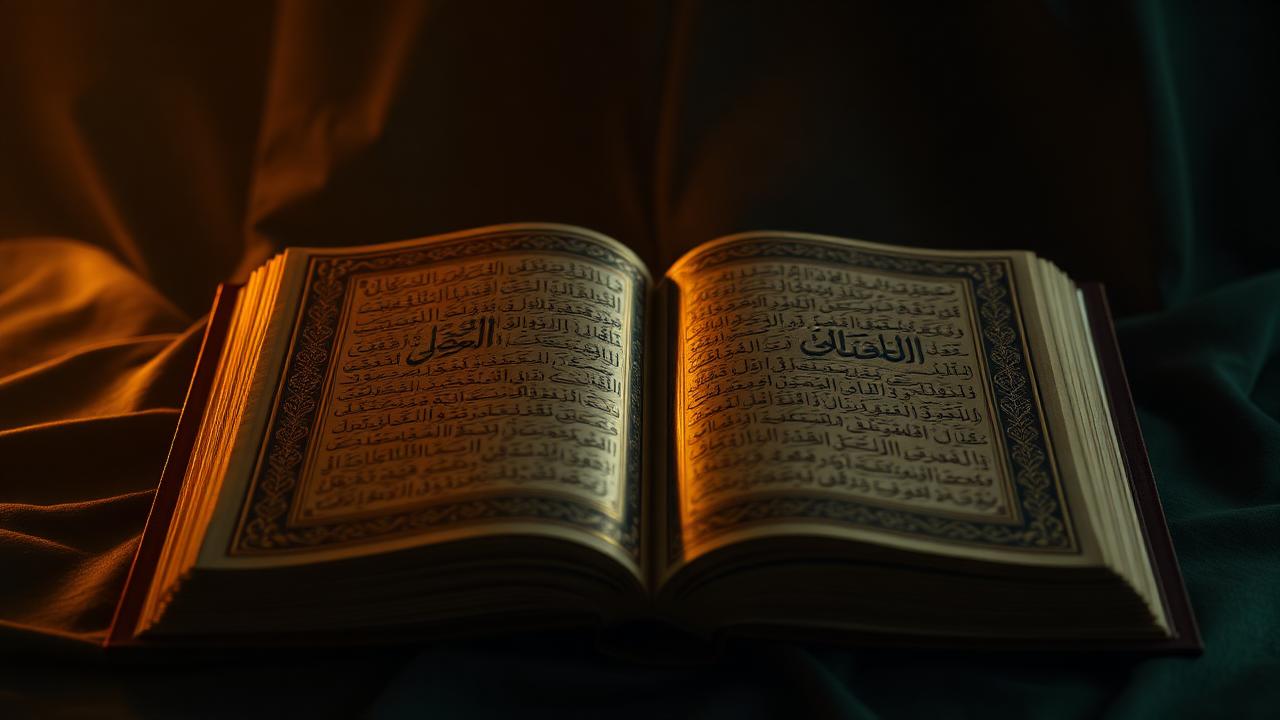
The Holy Qur'an
القرآن الكريم
Revelation to the Prophet Muhammad ﷺ · 610–632 CE
The complete Qur'an — 114 surahs and 6,236 verses — hosted on this site in Arabic with English and Urdu translation and recitation.
About this book
The Qur'an was revealed over roughly twenty-three years, first in Makkah and then in Madinah, and was preserved both in memory and in writing from the lifetime of the Prophet ﷺ onward.
Makkan surahs generally address belief, accountability and the moral reform of the individual; Madinan surahs deal more with law, community life, treaties and social justice.
On this site the entire text is stored locally, so the reader works offline-friendly and without depending on any outside service.
How it is arranged
- ▸114 surahs, ordered as in the standard mushaf
- ▸6,236 verses, divided into 30 ajza' for recitation
- ▸Arabic text with English and Urdu translation side by side
- ▸Verse-by-verse audio recitation
Full reading
Written for this library in our own words — 16 chapters.
1. History and Divine Compilation
The Holy Qur’an is viewed by Muslims as the verbatim word of God, revealed to the Prophet Muhammad through the Angel Gabriel over a period of twenty-three years. The revelation began in the cave of Hira in 610 CE and continued until the Prophet’s passing in 632 CE. Within the Ja’fari perspective and broader Islamic history, the preservation of the text is considered a miracle of divine protection. During the Prophet's lifetime, the verses were memorized by numerous companions and recorded on materials like parchment and date palms. The compilation process ensured that the sequence of verses within chapters was divinely directed. Imam Ali ibn Abi Talib is noted in history for having his own chronological compilation with detailed commentary, emphasizing the importance of the Ahl al-Bayt in safeguarding the text's integrity. For the believer, the history of the Qur’an is not merely a literary timeline but a testament to God's continuous guidance to humanity. A representative passage reflecting this preservation is found in Surah Al-Hijr 15:9: 'Indeed, it is We who sent down the Qur'an and indeed, We will be its guardian.' Scholars note that this promise of protection distinguishes the Qur’an from previous scriptures. Beginners should approach the history of the Qur’an as a story of oral and written devotion, recognizing that the text used today is identical to the one recited by the Prophet in the seventh century. Understanding this historical continuity builds the necessary trust required for deeper study.
2. Literary Structure and Composition
The structure of the Qur’an is unique, consisting of 114 chapters known as Surahs, which vary significantly in length. Rather than being organized chronologically, the chapters are generally arranged from longest to shortest, with the exception of the opening chapter, Al-Fatiha. Each Surah is composed of verses called Ayahs, meaning 'signs.' Scholars divide the revelations into two main periods: Meccan and Medinan. Meccan Surahs, revealed before the migration, typically focus on the oneness of God (Tawhid) and the afterlife. Medinan Surahs, revealed after the migration, often address social legislation, justice, and the governance of the community. In the Ja’fari tradition, the internal structure is also understood through the concept of Muhkam (clear) and Mutashabih (ambiguous) verses. A representative passage illustrating the importance of structure is Surah Al-Zumar 39:23: 'Allah has sent down the best statement: a consistent Book wherein is reiteration.' This suggests that the Qur’an’s structure is designed for rhythmic recitation and thematic reinforcement. For a beginner, the non-linear structure might seem daunting, but it is helpful to view the Qur’an as a tapestry where themes reappear in different contexts to offer a holistic worldview. One should not expect a narrative novel, but rather a guide that speaks to different aspects of the human condition across its various sections.
3. Key Themes and Theological Pillars
The core themes of the Qur’an revolve around the relationship between the Creator and the creation. The primary theme is Tawhid, the absolute oneness and uniqueness of God. Closely linked to this is the theme of Prophethood (Nubuwwah), detailing the lives of figures like Adam, Abraham, Moses, and Jesus to show the continuity of the divine message. Another central pillar is the Hereafter (Ma’ad), emphasizing accountability and the ultimate journey of the soul. Social justice, ethics, and the rights of the marginalized are also woven throughout the text. The Ja’fari school emphasizes the theme of Adalah (Divine Justice) and the necessity of leadership (Imamah) as inferred through the Quranic emphasis on obeying those in authority. A representative passage for these themes is Surah Al-Baqarah 2:177: 'Righteousness is not that you turn your faces toward the east or the west, but [true] righteousness is [in] one who believes in Allah, the Last Day, the angels, the Book, and the prophets and gives wealth, in spite of love for it, to relatives, orphans, the needy, the traveler, those who ask [for help].' Scholars use these themes to build the framework of Islamic law and theology. A beginner should look for these recurring motifs—mercy, justice, and monotheism—to find the 'heartbeat' of the text, which provides a moral compass regardless of the specific historical context of a verse.
4. Legal Framework and Scholarly Interpretation
The Qur’an provides the foundational principles for both individual conduct and communal law. Scholars of all schools, including the Ja’fari school, use the Qur’an as the primary source of Sharia (Islamic Law). However, because the Qur’an often provides general principles rather than minute details, scholars rely on the Sunnah (the traditions of the Prophet) and, in the Shi’a tradition, the teachings of the Imams to interpret these laws. This process, known as Ijtihad, involves a deep linguistic and historical analysis of the verses. Legal verses cover topics such as marriage, inheritance, trade, and criminal justice, always emphasizing equity. A representative passage regarding justice is Surah An-Nisa 4:135: 'O you who have believed, be persistently standing firm in justice, witnesses for Allah, even if it be against yourselves or parents and relatives.' Scholars also look at the 'reasons for revelation' (Asbab al-Nuzul) to understand the context of legal rulings. For a beginner, it is important to distinguish between the universal moral commands and the specific legal rulings. While the ethical calls are immediate, the legal interpretations often require the guidance of qualified scholarship to be applied correctly in a modern context. Reading the Qur’an with an eye for its legal principles reveals a text deeply concerned with the practicalities of building a fair and functioning society.
5. Spirituality and Inner Meaning
Beyond law and history, the Qur’an is a book of deep spirituality and inner transformation. It describes itself as a 'healing and a mercy' for the believers. The text encourages constant remembrance of God (Dhikr) and reflection (Tadabbur) on the natural world as a means to reach spiritual proximity to the Divine. In Ja’fari spirituality, the Qur’an is the 'Silent Imam,' while the Living Imam is the 'Speaking Qur’an,' representing the perfect embodiment of the text’s spiritual truths. The mystical layers of the Qur’an (Batin) are explored by seekers to find peace and purpose. A representative passage for this spiritual dimension is Surah Ar-Ra’d 13:28: 'Unquestionably, by the remembrance of Allah hearts are assured.' Scholars of spirituality focus on how the recitation of the Qur’an affects the soul, purifying it from arrogance and greed. For a beginner, the spiritual approach involves reading the text not just for information, but for transformation. One is encouraged to read slowly, perhaps only a few verses at a time, and allow the beauty of the language and the depth of the meaning to resonate personally. This meditative approach helps the reader move beyond a purely intellectual understanding toward a heart-centered connection with the divine message.
6. A Beginner’s Guide to Reading and Reflection
For those new to the Qur’an, the best approach is one of humility and openness. It is recommended to start with the shorter Surahs at the end of the book (Juz Amma), as these are often more rhythmic and focus on the fundamental relationship between the individual and God. Reading a reliable translation is essential, but beginners should be aware that no translation can fully capture the nuance of the original Arabic. In the Ja’fari tradition, it is highly encouraged to read the Qur’an alongside the 'Nahj al-Balagha' (Path of Eloquence) by Imam Ali, as his sermons provide a profound commentary on Quranic concepts. A representative passage for the seeker is Surah Al-Ankabut 29:69: 'And those who strive for Us - We will surely guide them to Our ways.' Beginners should not feel pressured to understand everything at once. Scholars suggest that the Qur’an is like an ocean; one can benefit from the view at the shore, but the deeper one dives, the more pearls one finds. Using a 'Tafsir' or commentary can help clarify difficult passages and provide historical context. The goal for a beginner is to establish a consistent habit of reading, allowing the text to become a companion that offers guidance, comfort, and intellectual stimulation throughout life's journey. Respectful engagement with the text involves both the mind and the heart.
7. Surah Al-Fatiha: The Opening and Its Central Place in Worship
Surah Al-Fatiha, though only seven verses, occupies an unmatched position in Muslim devotional life because it is recited in every unit of the daily prayers, making it the most repeated chapter of scripture in human history. It opens with praise, “All praise is for Allah, Lord of all the worlds” (Al-Fatiha 1:2), before moving through mercy, sovereignty over the Day of Judgment, and a plea for the “straight path.” Exegetes across schools, including Ja'fari commentators such as al-Tabataba'i in al-Mizan, note that the chapter functions as a concise summary of the entire Qur'an: affirmation of Tawhid, acknowledgment of divine mercy, recognition of accountability, and a request for guidance that only God can grant. The closing verse, “the path of those You have blessed, not of those who have incurred wrath, nor of those who are astray” (1:7), has generated extensive commentary regarding who is intended by these categories, with many Shi'a and Sunni exegetes alike associating true guidance with the path of the prophets, the truthful, the martyrs, and the righteous mentioned elsewhere in the Qur'an. Because it is repeated so often, scholars caution that believers must not recite it mechanically; rather, each repetition is meant to renew a conscious covenant between servant and Lord. Traditions attributed to the Imams describe Al-Fatiha as a conversation, where God responds to each verse the servant utters. For readers building a relationship with the Qur'an, Al-Fatiha serves as a doorway: understanding its structure of praise, sovereignty, worship, and petition equips the reader to recognize the same pattern echoed throughout longer chapters. Its brevity makes it an ideal starting point for memorization, while its depth ensures that even advanced scholars continue to write volumes unpacking its implications for theology, ethics, and the psychology of supplication.
8. The Throne Verse and the Architecture of Divine Attributes
Surah Al-Baqarah 2:255, known as Ayat al-Kursi or the Throne Verse, is widely regarded as the most theologically dense single verse in the Qur'an, and it has been the subject of independent treatises across the centuries. It declares, “Allah! There is no god but He, the Ever-Living, the Sustainer of existence. Neither drowsiness overtakes Him nor sleep. To Him belongs whatever is in the heavens and whatever is on the earth.” The verse systematically presents divine attributes: uniqueness, eternal life, self-subsistence, dominion, and knowledge that encompasses all things “except what He wills.” Ja'fari theologians have long used this verse to argue against anthropomorphism, since it emphasizes that God's throne, or Kursi, extends over the heavens and earth without any bodily limitation implied, a point elaborated in works like al-Shaykh al-Saduq's discussions of divine unity. The verse concludes, “His Kursi extends over the heavens and the earth, and their preservation tires Him not. He is the Most High, the Most Great,” reinforcing that sustaining creation requires no exertion from the Divine, unlike created beings. Traditions report that the Prophet and the Imams encouraged its recitation for protection, and it is commonly recited after obligatory prayers and before sleep. Commentators note its placement within Al-Baqarah, the longest chapter, at a point where the surah transitions from narratives about the Children of Israel to guidance on charity, compulsion in religion, and divine light, suggesting the verse anchors the chapter's legal and social teachings in a clear theological foundation. For readers, memorizing and reflecting upon this verse offers a compact creed, distilling centuries of theological debate about God's nature into a single, rhythmically balanced statement that has shaped Islamic art, architecture, and personal devotion across the Muslim world.
9. Surah Yusuf: Narrative Art and the Best of Stories
Surah Yusuf, the twelfth chapter, is unique in the Qur'an for narrating a single continuous story from beginning to end, and it opens with God's own description of it as “the best of stories” (12:3). The chapter follows Prophet Joseph from his prophetic dream of eleven stars, the sun, and the moon prostrating to him, through the betrayal by his brothers, his enslavement in Egypt, the trial with the wife of al-'Aziz, his years in prison, his rise to authority over Egypt's granaries, and his eventual reunion with his father Jacob and his brothers. Exegetes highlight the psychological realism of the narrative, particularly Joseph's declaration, “I do not absolve myself; indeed, the soul is a persistent enjoiner of evil” (12:53), which is often cited in discussions of the nafs and the stages of spiritual struggle described by Shi'a mystics and jurists alike. The chapter is equally celebrated for its treatment of patience, as seen in Jacob's repeated response, “Beautiful patience” (sabr jamil), even amid profound grief. Commentators such as al-Tabataba'i note that the surah demonstrates divine providence working through apparent calamity, showing that betrayal, imprisonment, and separation ultimately serve a wise and merciful plan culminating in reunion and honor. The story also carries juridical lessons drawn upon by scholars regarding testimony, evidence, and the protection of one's honor, since Joseph's innocence is eventually proven through circumstantial reasoning. For readers new to the Qur'an, Surah Yusuf offers an accessible entry point because of its narrative coherence, while for advanced students it opens onto deep reflections on trust in God, the trials of prophets, forgiveness of one's enemies exemplified when Joseph tells his brothers “no blame will there be upon you today” (12:92), and the ultimate triumph of righteousness over jealousy and deceit.
10. Surah Al-Kahf and the Four Trials of Faith
Surah Al-Kahf, the Cave, is traditionally recommended for recitation on Fridays and is structured around four distinct narratives that scholars describe as trials of wealth, knowledge, power, and faith itself. The first recounts the Companions of the Cave, young believers who fled persecution and were sheltered by God in a miraculous sleep lasting, according to the text, “three hundred years, and add nine” (18:25), illustrating the trial of religious persecution and the protection granted to those who flee for the sake of faith. The second narrative presents the parable of two garden owners, one arrogant in his wealth who declares “I do not think this will ever perish” (18:35), only to lose everything, contrasting worldly pride with humble gratitude. The third and most discussed narrative concerns Moses' encounter with al-Khidr, a figure endowed with esoteric knowledge “from Our own presence” (18:65), whose seemingly unjust actions—damaging a boat, killing a youth, and repairing a wall without payment—are later explained as containing hidden wisdom beyond apparent legal or ethical judgment. This account has been central to Shi'a and Sufi discussions of batini knowledge, the difference between exoteric law and esoteric wisdom, and the limits of human judgment when divine knowledge is at play. The fourth narrative follows Dhul-Qarnayn, a just ruler who travels to the ends of the earth and constructs a barrier against corruption, symbolizing righteous power exercised for the protection of the weak. Together these four stories address the perennial human trials that can compromise faith: religious persecution, material wealth, hidden knowledge, and political power. Scholars note the surah's warning against the deception of the Antichrist, or Dajjal, connecting Al-Kahf's recitation to spiritual protection. For the reader, the chapter functions as a manual for discernment, teaching that true security lies not in caves, gardens, hidden knowledge, or empires, but in reliance upon God alone.
11. Surah Al-Rahman: The Refrain of Divine Bounty
Surah Al-Rahman is distinguished by its refrain, “So which of the favors of your Lord will you both deny?”, repeated thirty-one times throughout its brief verses, addressed to both jinn and humankind. The chapter opens by attributing the teaching of the Qur'an itself to the Most Merciful, before cataloguing the sun and moon by precise calculation, the stars and trees that prostrate, the balance God has established in creation, and the raising of the heavens with justice as its measure, commanding humanity “not to transgress within the balance” (55:8). It proceeds through descriptions of the earth laid out for creatures, the fruits and fragrant plants, before turning to the creation of humankind from clay like pottery and jinn from smokeless fire. The chapter's latter portion offers vivid depictions of the two paradises promised to those who feared standing before their Lord, each with flowing springs, paired fruits, and companions described in exalted terms, alongside sobering descriptions of the recompense awaiting the wrongdoers. Commentators have long admired the surah's poetic symmetry and its function as a hymn of gratitude, teaching that recognition of divine favor, however small, is the beginning of true faith. Ja'fari scholars often connect the balance ('adl) mentioned in this chapter to the broader theological principle of Divine Justice central to Twelver theology, arguing that the created order itself testifies to a Just Creator whose favors demand a grateful and just response from creation. Traditions describe this chapter as the “bride of the Qur'an” due to its beauty, and it is frequently recited in gatherings of remembrance and at funerals as a reminder of both divine generosity and the transient nature of worldly life. For the reader, the sheer repetition of the refrain trains the heart to actively count blessings rather than take them for granted, transforming passive reading into an act of continuous gratitude.
12. Surah Al-Hujurat: The Ethics of Community Life
Surah Al-Hujurat, though comparatively short, is one of the Qur'an's most concentrated sources for the ethics of social conduct, addressing believers directly with a series of prohibitions and positive commands meant to preserve the dignity of the community. It opens by instructing believers not to raise their voices above that of the Prophet, establishing principles of respect for legitimate authority, before moving to one of the Qur'an's most cited verses on caution regarding information: “O you who have believed, if there comes to you a disobedient one with information, investigate, lest you harm a people out of ignorance” (49:6), a verse foundational to Islamic legal discussions on the reliability of reports and the ethics of journalism and rumor in the contemporary period. The chapter continues with instructions on reconciling between believers who fight one another, insisting that “the believers are but brothers, so make settlement between your brothers” (49:10). It then delivers a forceful set of prohibitions against mockery, derision, offensive nicknames, suspicion, spying, and backbiting, memorably comparing backbiting to “eating the flesh of one's dead brother” (49:12), an image exegetes note is meant to provoke visceral revulsion toward a sin often treated casually in daily speech. The chapter closes with the celebrated verse on human diversity: “O mankind, indeed We have created you from male and female and made you peoples and tribes that you may know one another. Indeed, the most noble of you in the sight of Allah is the most righteous of you” (49:13), a verse frequently invoked in discussions of racial and ethnic equality within Islamic thought. Ja'fari commentators emphasize that the surah closes by distinguishing between mere verbal submission, or Islam, and true faith, Iman, which requires striving with wealth and life. For readers, this surah functions almost as a constitution for interpersonal ethics, offering concrete, actionable guidance for building communities free of slander, tribalism, and hasty judgment.
13. Surah Al-Ahzab and the Verse of Purification
Surah Al-Ahzab, the Confederates, recounts the Battle of the Trench and addresses the household of the Prophet directly in verses that have generated centuries of theological discussion, particularly among Shi'a Muslims. Central among these is verse 33:33, commonly known as Ayat al-Tathir, the Verse of Purification: “Indeed, Allah intends to remove from you the impurity, O people of the Household, and to purify you with a thorough purification.” Ja'fari exegetes, drawing on hadith transmitted through numerous Sunni and Shi'a chains alike, hold that this verse was revealed specifically regarding the Prophet, Fatima, Ali, Hasan, and Husayn, who were gathered under a cloak when the verse descended, an event commemorated as the Hadith of the Cloak. This verse forms a central scriptural pillar for the doctrine of the infallibility ('isma) of the Ahl al-Bayt in Twelver theology. The chapter also narrates the community's trials during the siege of Medina, describing the hearts of the hypocrites as reaching “to the throats” from fear (33:10), and it addresses matters of social legislation including adoption practices, modesty, and the unique responsibilities placed upon the Prophet's wives, who are told they are “not like anyone among women” if they remain God-conscious (33:32). The chapter closes with the weighty verse on the Trust, describing how the heavens, earth, and mountains declined to bear the responsibility offered to them, while “man undertook to bear it; indeed, he was unjust and ignorant” (33:72), a verse central to discussions of human free will and moral accountability. For the reader, Al-Ahzab illustrates how historical narrative, social legislation, and profound theological declarations are interwoven within a single chapter, requiring careful study of both the immediate context of the Trench and the far-reaching doctrinal implications drawn from its verses regarding the status of the Prophet's family.
14. Surah Al-Insan and the Vow of the Righteous
Surah Al-Insan, also called Al-Dahr, is renowned in Shi'a exegetical literature for verses believed to have been revealed concerning Ali, Fatima, Hasan, and Husayn, who, according to widely transmitted reports, fasted for three days after fulfilling a vow and gave their only food each evening to a poor man, an orphan, and a captive, saying only, “We feed you only for the countenance of Allah. We wish not from you reward or gratitude” (76:9). The surah opens by describing the creation of the human being from a mixed sperm-drop, testing him, and giving him hearing and sight, before presenting a stark choice between the paths of gratitude and ingratitude. It then elaborates in vivid detail the recompense awaiting the righteous: garments of fine green silk, silver vessels, a spring called Salsabil, and youths of perpetual freshness serving among them, imagery that Islamic art and literature have drawn upon extensively when depicting paradise. Commentators highlight how the chapter moves seamlessly from a specific historical act of charity to universal principles about sincerity in worship, arguing that the family's example illustrates the Qur'anic ideal of selfless charity performed purely for God's sake rather than for social recognition. The chapter also contains verses urging patience with the “judgment of your Lord” and warning against obeying “a sinful one or ungrateful disbeliever” among them (76:24), read by scholars as guidance for believers navigating social and political pressures. Toward its conclusion, the surah reminds humanity that this is a reminder, and “whoever wills let him take to his Lord a way” (76:29), affirming free will within a framework of ultimate divine sovereignty. For readers, this chapter offers both a moving narrative of familial piety and a template for evaluating the sincerity of one's own charitable acts, asking whether they are performed for divine pleasure alone or tainted by desire for praise.
15. Surah Al-Qadr and the Night of Power
Surah Al-Qadr, though only five verses, addresses one of the most significant nights in the Islamic calendar, the Night of Decree, during which the Qur'an itself began its descent: “Indeed, We sent the Qur'an down during the Night of Decree. And what can make you know what is the Night of Decree? The Night of Decree is better than a thousand months” (97:1-3). Exegetes across traditions have debated the exact date of this night, though it is widely associated with the odd nights of the last ten days of Ramadan, with the twenty-third night receiving particular emphasis in numerous narrations from the Imams. The chapter describes angels and the Spirit descending “by permission of their Lord for every matter,” a verse Ja'fari theologians connect to broader doctrines regarding the ongoing disposition of divine decrees and the special role of the Spirit, or Ruh, understood by many commentators as a created being of immense rank distinct from the angels. The chapter concludes describing the night as “peace until the emergence of dawn,” conveying a sense of tranquility and safety that descends upon creation during those sacred hours. Traditions attributed to the Imams encourage extensive worship, supplication, and recitation of the Qur'an during these nights, viewing them as an opportunity for the annual renewal of one's spiritual record. Some Shi'a scholars have also linked the theme of decree to the ongoing guidance provided through the Imamate, arguing that just as the Qur'an descended gradually with continuing relevance, divine guidance for the community likewise continues through appointed leadership after the Prophet. For readers, this chapter, brief as it is, opens a doorway into a vast field of devotional practice, encouraging Muslims each year to seek out this night through vigil, prayer, and reflection, treating it as an anniversary of revelation itself rather than merely a historical footnote.
16. Surah Al-Zalzalah and the Weighing of Atoms
Surah Al-Zalzalah, the Earthquake, is a short Meccan chapter whose vivid apocalyptic imagery has made it a frequent subject of eschatological commentary. It opens with the earth shaking with its “convulsion” and casting out its burdens, at which point humanity asks, bewildered, “What is with it?” (99:3), before the earth itself testifies to what occurred upon it, “because your Lord has commanded it” (99:5), a verse commentators use to illustrate the Qur'anic theme that even inanimate creation will bear witness on the Day of Judgment, reflecting a cosmos that is fully responsive to and aware of divine command. The chapter culminates in one of the most frequently cited verses regarding moral accountability: “So whoever does an atom's weight of good will see it, and whoever does an atom's weight of evil will see it” (99:7-8). Ja'fari and Sunni jurists alike have drawn upon this verse to argue that no act, however small, is insignificant before divine justice, reinforcing the broader Qur'anic doctrine of comprehensive accountability that undergirds Islamic ethics and law. The verse's precision—specifying even the smallest conceivable unit, traditionally understood as the weight of an atom or a tiny ant—has made it a favorite for moral instruction directed at children and adults alike, illustrating that neither small acts of kindness nor minor transgressions escape divine record. Exegetes note the surah's placement near the end of the Qur'an as part of a cluster of short, powerful chapters describing the Last Day with escalating intensity, preparing the reader for the final declarations of divine unity in the chapters that follow. For the reader, this chapter functions as a concise ethical reminder that can be recalled in daily decision-making, prompting reflection before both grand and seemingly trivial actions, since ultimate reckoning rests not on scale but on sincerity and intention before God.