The Islamic Golden Age Observatories: Maragha, Samarkand, and a Shared Science
A historical guide to the observatories of Maragha and Samarkand, their instruments, collaborative institutions, and the careful transmission of astronomical knowledge across cultures.
The Islamic Golden Age Observatories: Maragha, Samarkand, and a Shared Science
Astronomy in medieval Muslim societies was not a single project with one capital or one method. It was a centuries-long conversation among observers, mathematicians, instrument makers, translators, patrons, and scholars who needed reliable ways to measure time and direction. The observatories at Maragha in Iran and Samarkand in Central Asia became especially influential because they joined sustained observation to mathematical criticism and institutional teaching. Their history is a reminder that science grows through shared work: Greek, Persian, Indian, Arabic, and later Central Asian traditions met in places where scholars tested inherited models against new measurements.
This essay introduces those institutions without treating them as isolated monuments. It explains practical reasons for observation, how an observatory functioned, what changed at Maragha and Samarkand, and what the record can—and cannot—show about influence.
Why observe the sky?
Practical questions and mathematical inquiry
The sky served everyday, religious, and scholarly needs. The lunar calendar gave months their structure; the Sun helped determine prayer times; and the direction of the Kaaba required geographical and mathematical work. Navigation, agriculture, courtly timekeeping, and astrology also generated demand for tables and instruments. These uses did not make astronomy less intellectual. They created questions requiring geometry, arithmetic, and repeated measurement.
Muslim astronomers inherited substantial bodies of work, including Ptolemy’s mathematical astronomy, translated and studied in Arabic. They did not simply copy it. They checked tables, compared calculations with observations, and proposed new geometrical devices when existing models seemed unsatisfactory. Astronomical handbooks (zijes) collected procedures and numerical tables for computing planetary positions and calendars. Their accuracy depended on observation and on a tradition of mathematical review.
Qur’anic language about the regular courses of the Sun and Moon encouraged reflection on creation, while the technical science developed through mathematics and observation. These are related but distinct forms of inquiry. A responsible account can honor the spiritual setting of scholarship without claiming that a modern discovery is encoded in a verse.
Maragha: a research institution in the thirteenth century
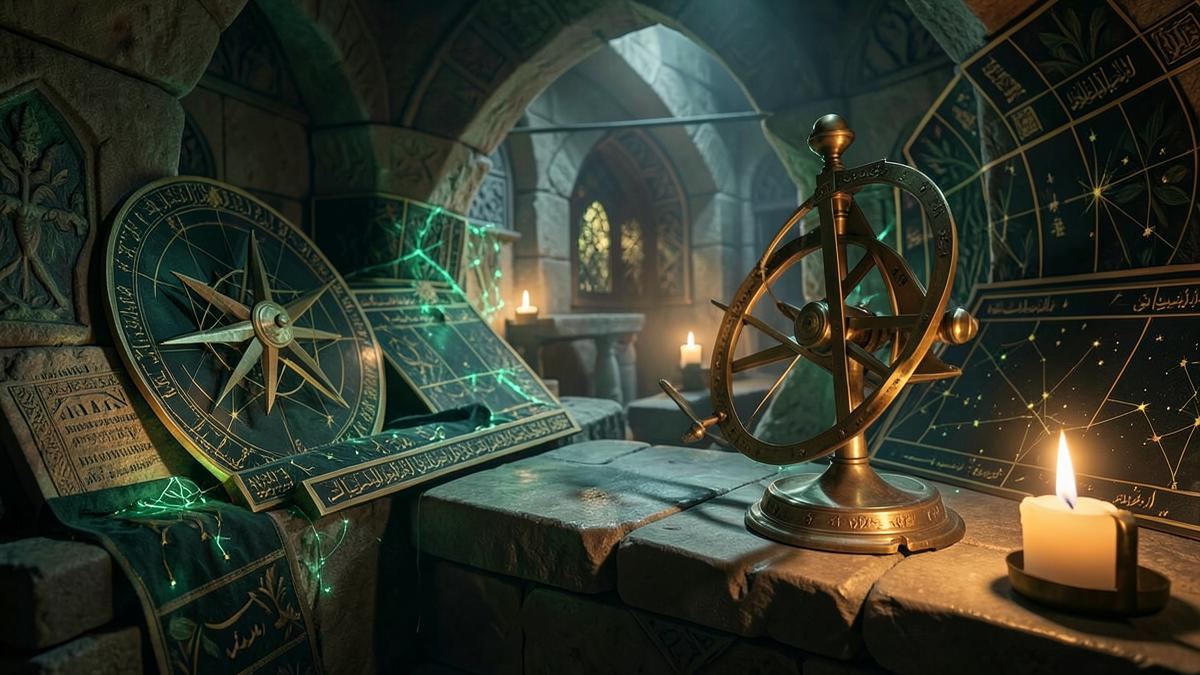
Nasir al-Din al-Tusi (d. 1274) directed the Maragha observatory, founded under Ilkhanid patronage in the mid-thirteenth century. It was more than a building with an instrument. It was an organized site with large observational devices, a library, skilled staff, and the support needed to keep work going. Instruments included devices for measuring angular positions, such as mural quadrants and armillary structures. These allowed observers to record celestial positions more consistently than unaided sight alone.
Al-Tusi and colleagues produced the Ilkhanic Tables (Zij-i Ilkhani), a major set of astronomical tables. The project drew on inherited models and observations made at Maragha. Its importance lies not in solving every problem but in combining sustained observation with theoretical work. A team could compare predictions with measured positions, identify disagreement, and revise calculations or models.
Al-Tusi is also associated with a geometrical construction now called the “Tusi couple,” a way to represent linear motion through two circular motions. The construction illustrates a broader point: medieval astronomers sought mathematical models that addressed problems in planetary theory. Historians debate how devices traveled and how later European models relate to them. Similarity alone does not prove direct borrowing; documentary evidence, chronology, and mathematical details must be compared.
Samarkand: observation, education, and Ulugh Beg
In the fifteenth century, the Timurid ruler and scholar Ulugh Beg (1394–1449) sponsored a major observatory at Samarkand, generally dated to the 1420s. Its best-known instrument was a monumental meridian arc, built into the ground and aligned to measure the altitude of celestial objects as they crossed the meridian. Its scale helped improve angular measurement. Archaeological remains and textual descriptions inform historians, though not every detail of its original arrangement is recoverable.
Ulugh Beg’s Zij-i Sultani brought together a star catalogue and tables. The catalogue’s coordinates were based on observations associated with Samarkand, and its values remained useful to later astronomers. The research team included scholars such as Qadi-zada al-Rumi and Ali Qushji. Their collective work shows that a ruler’s name on a project does not mean one person performed every calculation. Institutions depended on trained collaborators, mathematical exchange, instrument construction, and records.
Samarkand connected research and education. The city’s madrasa supported mathematical and astronomical study, and scholars moved between teaching, calculation, and observation. Instruments alone do not create a science. Students need texts, methods, and a community able to compare results. The observatory is best understood as part of an intellectual environment rather than a solitary wonder.
Instruments, tables, and accuracy
Pre-telescopic observation relied on sighting devices, graduated scales, careful alignment, and repeated readings. Astrolabes helped solve practical problems involving time and celestial altitude; large observatory instruments enabled measurement of particular angles. Tables then turned measurements and models into usable calculations. Errors could arise from alignment, atmospheric conditions, copying, arithmetic, or a model’s assumptions. Astronomers addressed them through calibration, comparison, and correction.
Accuracy must be judged against the instruments and methods available at the time. Medieval observatories could not achieve the precision of a modern radio telescope, but they could improve records inherited from earlier generations and build coherent mathematical systems. Their achievements are meaningful in their setting; they need no exaggerated claims to be impressive.
A network rather than a contest
Knowledge moved across languages and regions. Arabic was a major scholarly language, and translation brought Greek works into conversation with Arabic scholarship. Persianate courts supported research; Indian numerical methods entered wider mathematical practice; scholars from many ethnic and religious backgrounds contributed. Later translations, travel, and movement of instruments and tables connected parts of this work to other regions.
It is difficult to trace one discovery along a simple line from one observatory to a later European thinker. Manuscripts can be copied, adapted, and reinterpreted; mathematical constructions may emerge independently; evidence is incomplete. Good history states its evidence and limits. It neither erases Muslim contributions nor turns every parallel into proof of direct influence.
What these observatories teach
Maragha and Samarkand show how support can sustain long-term research, how instruments and theory can correct one another, and how skilled teams preserve knowledge. They also show why science needs openness: a table is useful only when readers can inspect assumptions and compare it with observation. These lessons remain relevant even though modern methods and institutions are different.
The observatories were working places in which scholars measured, calculated, taught, and revised. Their legacy is clearest when we study texts and instruments carefully, credit collaborators, and place achievements within a connected history of science.
Reading the surviving record
The evidence for these institutions is distributed across instruments, archaeological remains, biographies, astronomical handbooks, and later histories. No one source tells the complete story. A text may describe the purpose of an instrument but not preserve its dimensions; an archaeological foundation may show the scale of a building but not identify every scholar who worked there. Historians therefore compare independent kinds of evidence and distinguish a contemporary record from a later account that may idealize a patron or institution.
It is also useful to distinguish patronage from intellectual authorship. A ruler could commission an observatory, provide salaries, and protect a library, while the calculations depended on a team of specialists. The names that survive in manuscripts are not necessarily the entire staff. Some artisans and assistants may have left no written record at all. Recognizing this gap makes the history more accurate and gives institutional labor its proper place.
The term “Islamic astronomy” can describe scholarship developed in societies shaped by Islam and often written in Arabic or Persian; it should not imply a single religious method or a uniform political world. Scholars argued with one another, revised inherited theories, and sometimes practiced astrology alongside mathematical astronomy. A careful history can describe those complexities without either idealizing the past or denying the extraordinary skill demonstrated by its mathematical work.
References and further reading
- UNESCO, “The Evolution of Astronomy along the Silk Roads”: regional exchange and observatories.
- UNESCO/ICOMOS/IAU, Thematic Study on Astronomical Heritage: Maragha and Samarkand observatories.
- Encyclopaedia Iranica, “Ṭusi, Naṣir-al-Din”: al-Tusi’s life and scholarship.
- Cambridge University Press, “The Observatory in Samarqand”: Ulugh Beg’s observatory.
Historical note: dates and reconstructions follow the cited scholarly sources; details of influence between observatories and later European astronomy remain under specialist study.
Related Islamic Products
View shopLost Islamic History
Firas Alkhateeb
A broad narrative introduction to Muslim societies, institutions, and intellectual history across regions and periods.
Muslims Who Changed the World
A popular-history title about notable Muslim figures; the exact author and contents depend on the edition linked by the retailer.
Amazing Muslims Who Changed the World
Burhana Islam; illustrated by a team of artists
An illustrated introduction for younger readers to Muslim figures in science, public life, sport, and the arts.
Historic Research on the 12 Imams
A title covering the lives and historical setting of the Twelve Imams (a.s.); the edition and author should be checked against the publisher record.
As an Amazon Associate I earn from qualifying purchases.
Continue your study